
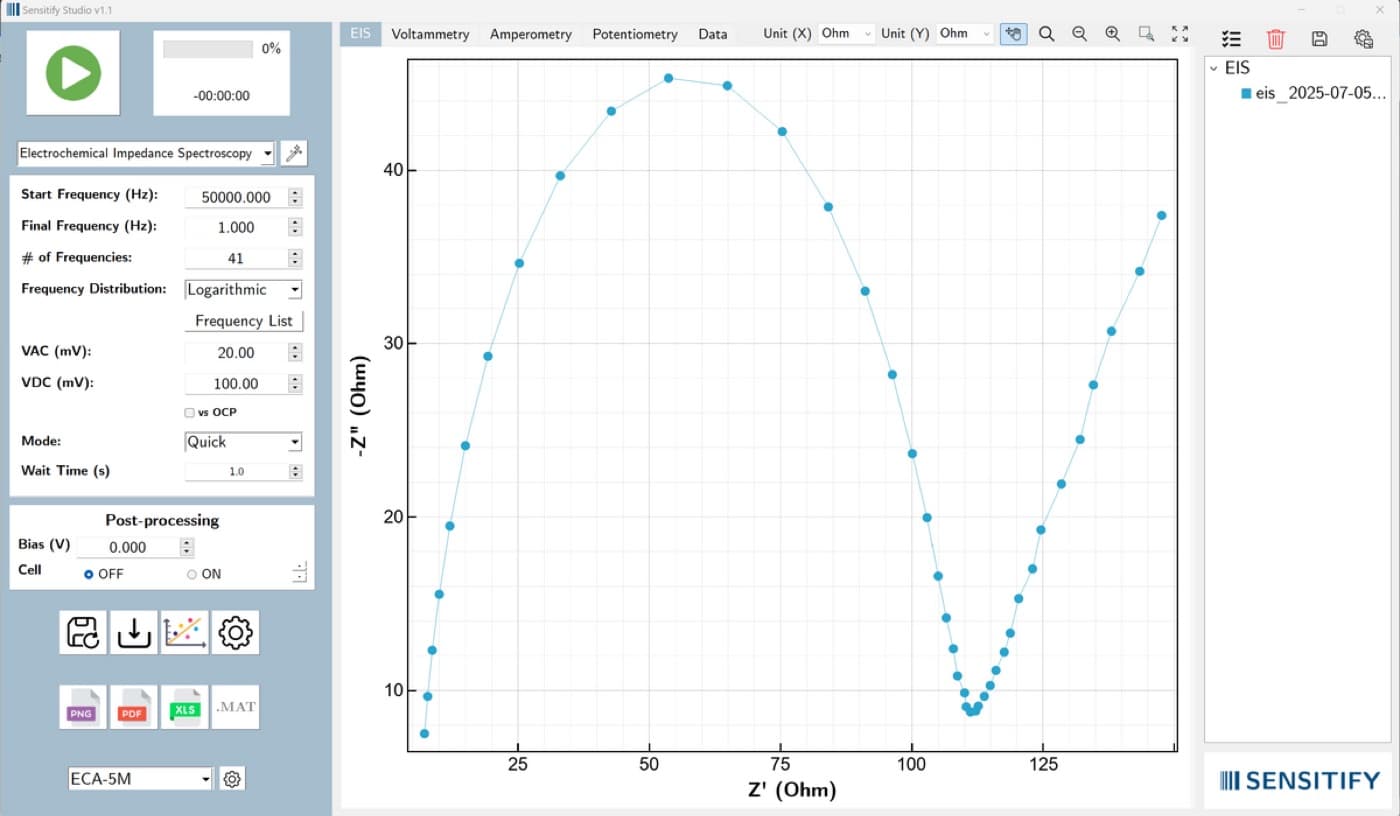
Five parameter choices determine the quality of an EIS measurement.
Step 1: Amplitude selection. The applied AC amplitude must be small enough to keep the system in its linear regime, but large enough to give a measurable response. 5–10 mV RMS is a reasonable starting point for aqueous systems.
Step 2: DC bias. Pick a DC bias that places your sensor in the operating point of interest, often the open-circuit potential or a redox formal potential.
Step 3: Frequency range. Cover the range that captures the timescales of your physical processes. For most aqueous biosensors, 100 kHz down to 0.1 Hz is a good default.
Step 4: Quiet time. Allow the system to settle at the DC bias before starting the sweep, especially after switching potentials.
Step 5: Post-processing. Inspect the Bode and Nyquist plots, fit an equivalent circuit, and report goodness of fit alongside extracted parameters.